

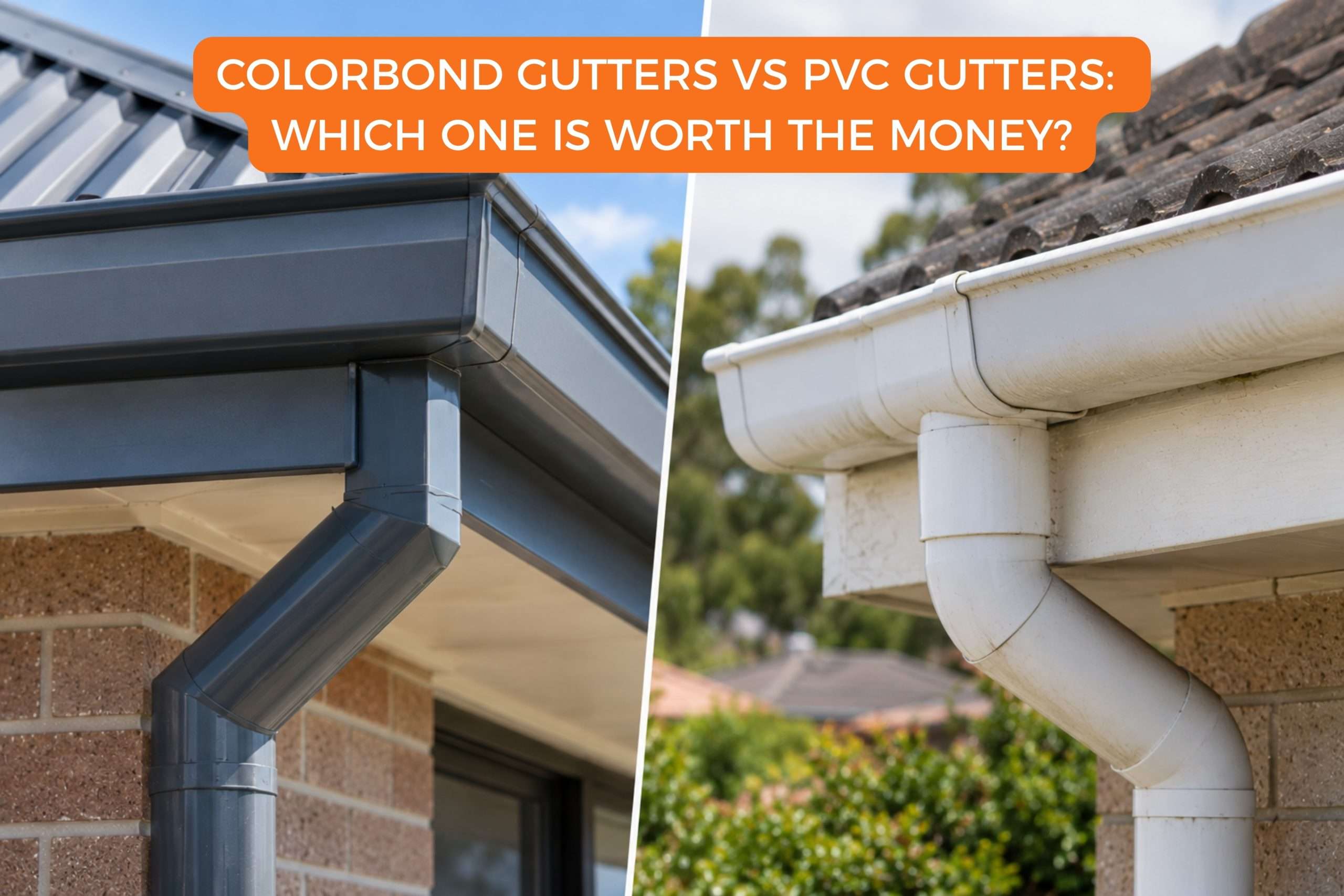
If you’ve been quoted for both Colorbond and PVC gutters, you’ve probably noticed the price gap straight away. PVC looks like the easy win. It costs less upfront and is quicker to install. Most articles on this topic will tell you Colorbond is “better” without explaining why, which leaves you comparing two products without understanding what the price difference is actually paying for.
Here’s the actual technical case, based on how each material behaves in Melbourne’s climate over the long term, so you can make the call with the full picture rather than a vague recommendation.
Manufacturing and Material Differences
Colorbond gutters are roll formed from steel coil, manufactured by BlueScope, that has been coated with a baked on paint finish, giving the metal a rigid, structural profile that holds its shape under load.
PVC gutters are extruded from plastic resin, which makes them lighter and cheaper to produce, but also more flexible and more prone to movement.
That difference in rigidity matters more than most homeowners realise. A steel gutter holds its fall and its joints under a full load of water and debris. A PVC gutter, being softer, can sag over time, especially over longer runs or where brackets are spaced too far apart.
Because PVC has less inherent stiffness, it generally needs closer bracket spacing to maintain the correct fall toward the downpipes, and any settling in the fascia or roofline over time is more likely to show up as a visible dip in a PVC system than in a Colorbond one.
How Melbourne's Climate Affects Each Material
Temperature Swings and Thermal Expansion
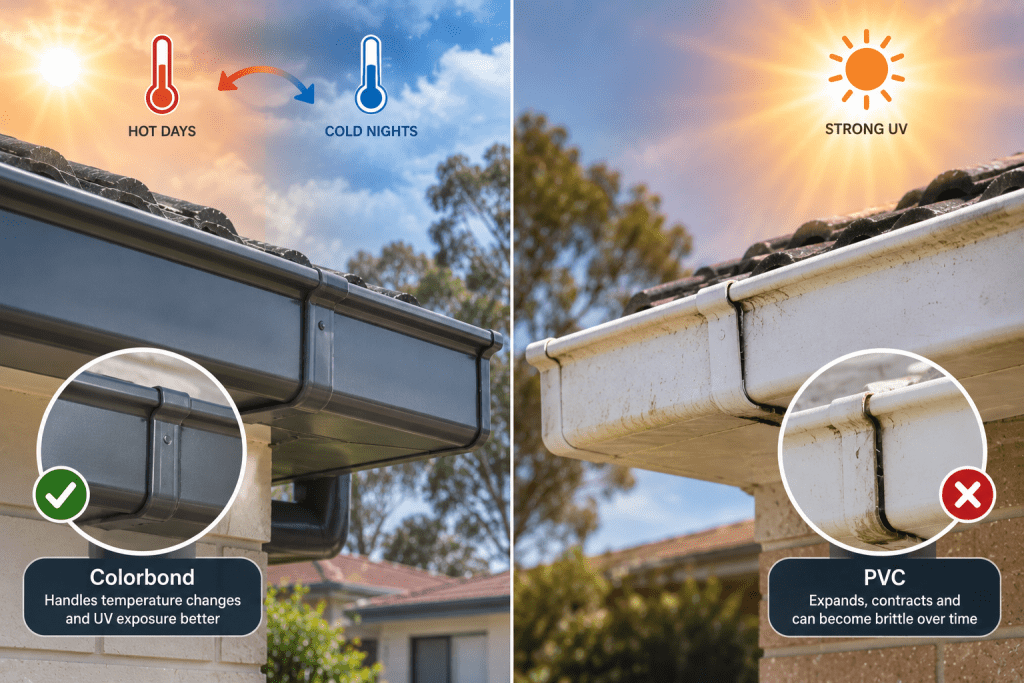
Melbourne’s daily and seasonal temperature swings put real stress on gutter materials, and PVC and steel do not respond the same way. Melbourne is well known for swinging through several distinct temperature changes in a single day, and as a general materials principle, plastic expands and contracts more than steel across the same temperature range.
Over repeated hot and cold cycles, that extra movement puts strain on PVC joints and seals, which are usually the first point of failure. A gutter that goes through a hot northerly afternoon followed by a cool overnight change, day after day through summer, is essentially being flexed on a constant cycle, and PVC feels that far more than metal does.
Colorbond, being a metal product, expands and contracts far less. Its joints are typically riveted and sealed rather than simply fitted, giving it more resistance to the kind of gradual joint separation that shows up in PVC systems after a few Melbourne summers. Where a Colorbond joint might need attention decades in, a PVC joint under the same conditions can start showing gaps or leaks much earlier.
UV Exposure and Degradation
Australian UV levels are harsh on unprotected plastics, and it’s well documented that PVC exposed to direct sun can become brittle and start to fade or chalk on the surface over time. Brittle PVC is more likely to crack under impact, whether from a ladder, a falling branch, or someone walking the roofline during a gutter clean.
Roof sections that get long, direct sun exposure through the day tend to show this wear earliest, which is worth keeping in mind if your home has large north or west facing roof planes.
Colorbond’s factory applied coating is designed specifically to resist UV fading and degradation, which is part of why the finish tends to still look presentable well after a PVC system of the same age has started to visibly deteriorate. This is also why Colorbond holds its colour more consistently over time, whereas faded or chalky PVC is a common sight on older Melbourne homes.
Lifespan and Long-Term Cost Comparison
Lifespan Comparison
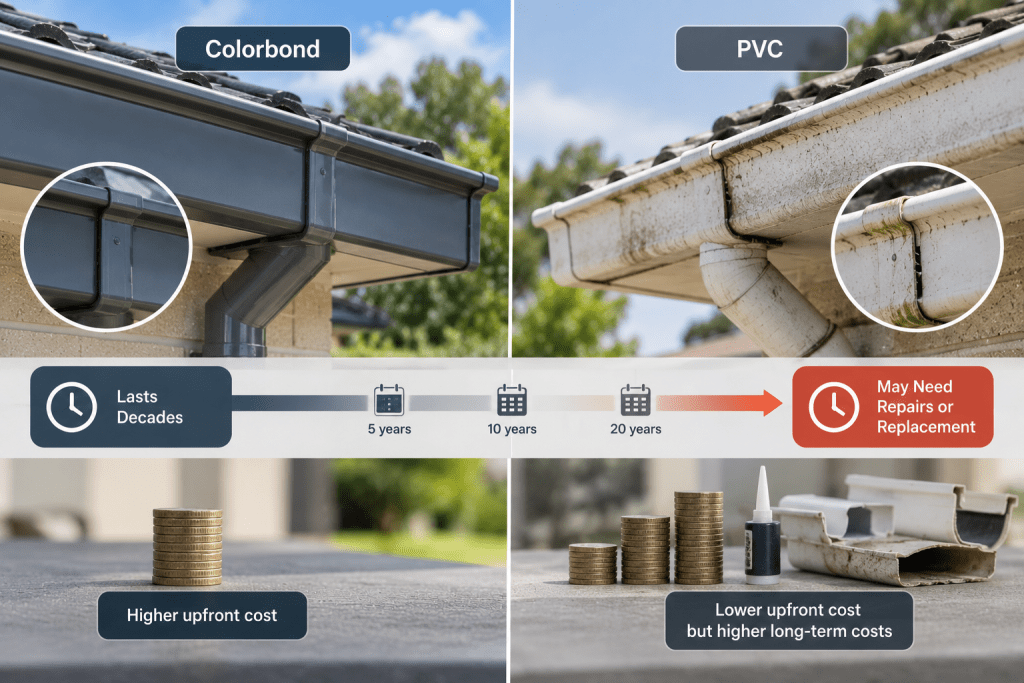
Colorbond gutters, properly installed, are generally expected to outlast PVC gutters by a wide margin, often lasting several decades under normal conditions. PVC gutters tend to show their age sooner, particularly in exposed, sun heavy positions on the roof, and are more likely to need partial repairs or full replacement well before a Colorbond system would.
Actual lifespan for both materials depends on installation quality, roof exposure, and how well the gutters are maintained, so it’s worth asking any installer what lifespan they would genuinely stand behind for your specific roof rather than relying on a general figure.
Cost Over a 20-Year Horizon
The upfront price gap favours PVC, but that gap narrows and can reverse once you look at a 20-year window. Colorbond is typically a one-off cost with minimal maintenance beyond routine cleaning.
PVC, by contrast, is more likely to need joint resealing, section replacement, or a full regutter within that same period, particularly on north or west facing rooflines that cop the most sun. Each of those interventions carries its own labour cost on top of materials, and if a section fails during a storm, there’s also the cost of any water damage to fascia, eaves, or foundations to factor in.
For homeowners weighing this up locally, it’s worth getting a proper gutter replacement cost quote for your specific roof before deciding, since catchment area and roof complexity affect the price more than the material choice alone.
When PVC Still Makes Sense and When It's a False Economy
PVC is not always the wrong choice. It can be a reasonable option for short-term situations, such as:
- An investment property being sold within a few years
- A granny flat or shed with a short expected life
- A tight budget where the gutters are a lower priority than other works
In these cases, the homeowner is unlikely to be around long enough to feel the downsides that show up later, so the lower upfront cost genuinely makes sense.
Where PVC becomes a false economy is on a long-term family home, especially one with north or west facing roof sections that get heavy sun exposure. In that scenario, the lower upfront cost is often outweighed by earlier failure, repeated repairs, and the cost and disruption of an eventual full replacement, which can end up costing more in total than installing Colorbond from the start.
If you’re planning to stay in the property for the long haul, it’s worth weighing the full 20-year picture rather than just the quote in front of you.
Get a Gutter Assessment From Roof Plumber Melbourne
If you’re weighing up Colorbond against PVC for your own roof, the right answer depends on your roof orientation, sun exposure, and how long you plan to stay in the property. Our team can assess your gutters and give you a straightforward recommendation, without pushing you toward the more expensive option unnecessarily.
We’ll look at your roof catchment, existing gutter condition, and sun exposure before recommending a material, so you get an answer suited to your specific home rather than a generic pitch. Get in touch with Roof Plumbers Melbourne for a gutter assessment.