

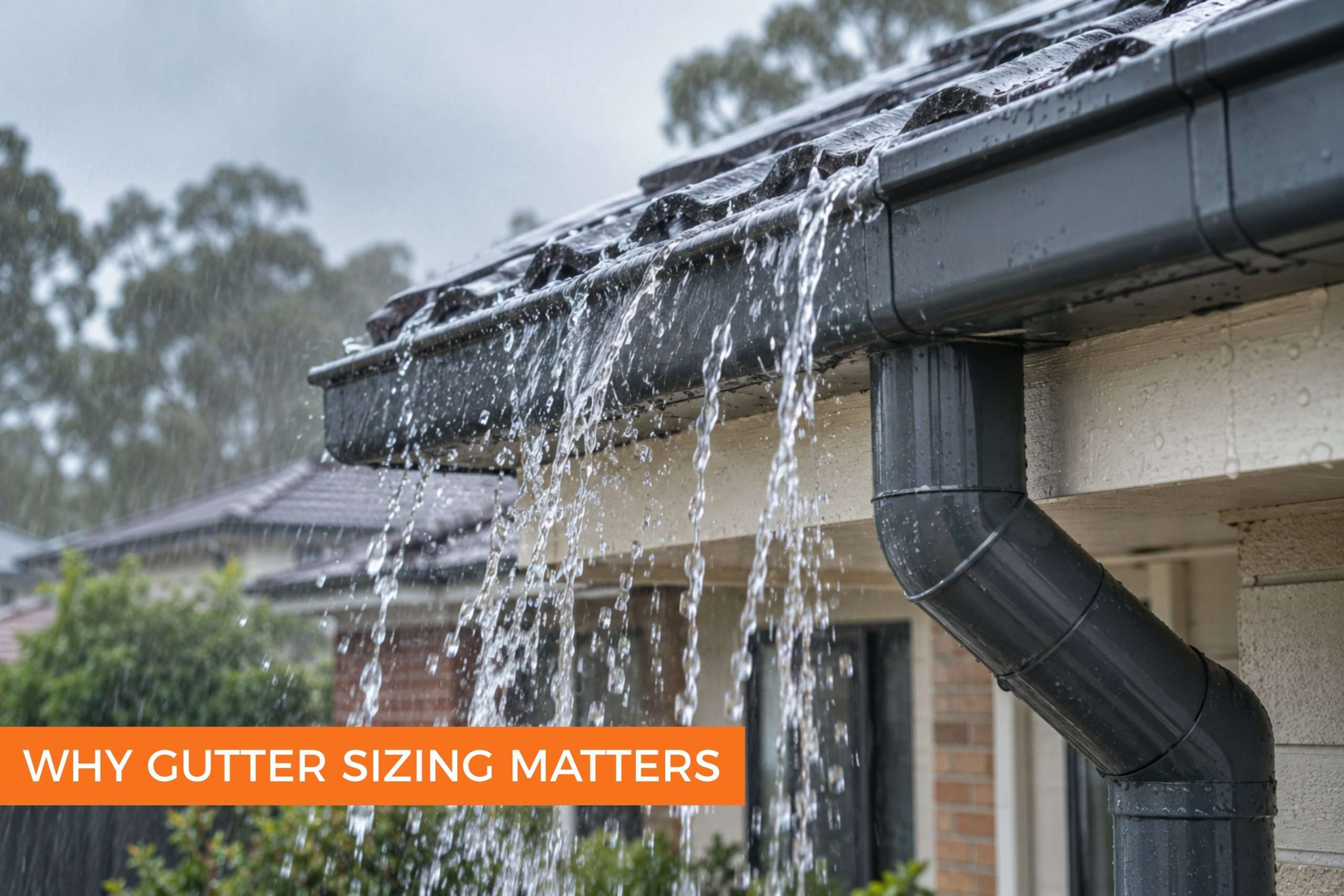
Why Gutter Sizing Matters and What Happens When It's Wrong
If your gutters overflow every time Melbourne gets a decent downpour, the problem often isn’t damage or blockage. It’s that the gutters were never sized for the roof they’re on. Gutter overflow like this is especially common in homes that have had an extension, a new deck roof, or extra roof area added since the original gutters went in, without the drainage being upgraded to match.
Here’s how gutter sizing actually works, what goes wrong when it’s wrong, and how to know which fix your home needs.
How Gutter Sizing Is Calculated
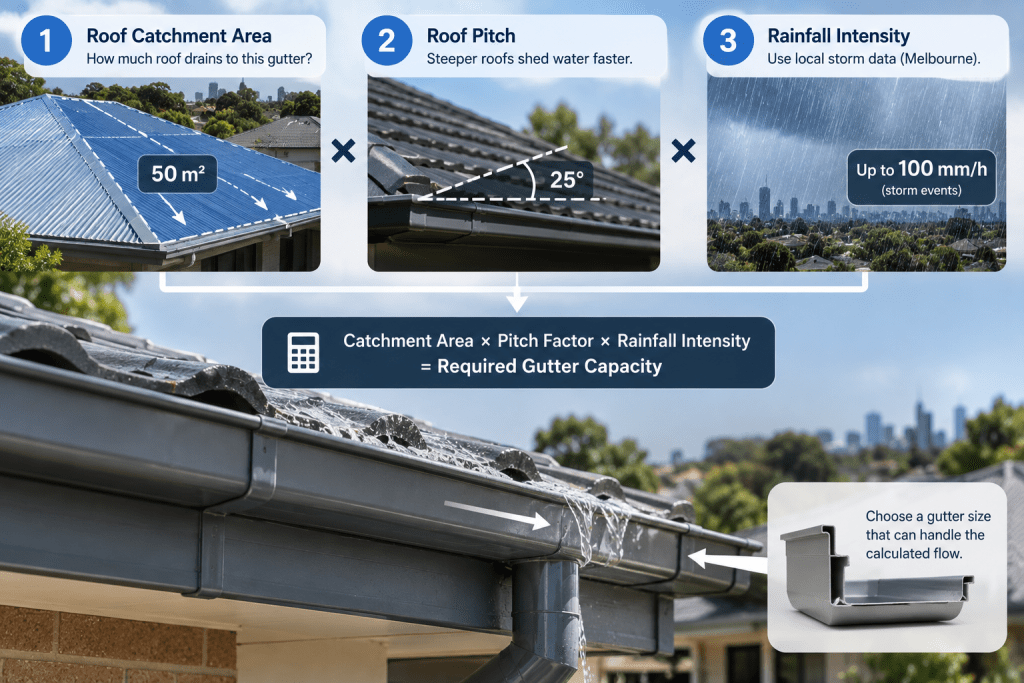
Roof Catchment Area, Pitch and Rainfall Intensity
Gutter size isn’t a one-size-fits-all decision. It’s calculated from three main factors: the roof’s catchment area, its pitch, and the rainfall intensity it needs to handle.
Catchment area is simply how much roof surface drains into a given length of gutter. A larger roof section, or one where multiple roof planes funnel into a single gutter run, sends significantly more water to that section than a small, standalone roof would.
Pitch matters too, because a steeper roof sheds water faster than a low-pitched one, which means the same rainfall intensity translates into a higher peak flow rate into the gutter. A gutter sized correctly for a small, low-pitched roof section can be completely undersized once it’s also collecting runoff from a steep, extended roofline.
Rainfall intensity, meaning how much rain falls in a short, heavy burst rather than a gentle drizzle, is the third input, and it’s the one most homeowners never think about. Gutters are sized to cope with peak intensity, not average rainfall, because that’s the condition under which they actually fail.
Melbourne's Storm Rainfall Figures
Melbourne’s rainfall is generally moderate across the year, but the figure that matters for gutter sizing isn’t the annual average. It’s the short, intense downpours that show up during summer storms and occasional East Coast Low events, when a large volume of rain falls in a short window.
Rainfall intensity also varies noticeably across Melbourne’s suburbs, and a sheltered, established area can see quite different peak intensity to a more open, exposed site, which is part of why a gutter size that works fine on one property can be genuinely undersized on another with a similar roof.
This is why gutter sizing should be based on the specific site’s rainfall intensity data, not a generic assumption carried over from whatever size the original builder installed. A proper sizing calculation using current, localised rainfall figures is the only reliable way to know whether an existing gutter run can actually cope.
Signs Your Gutters Are the Wrong Size
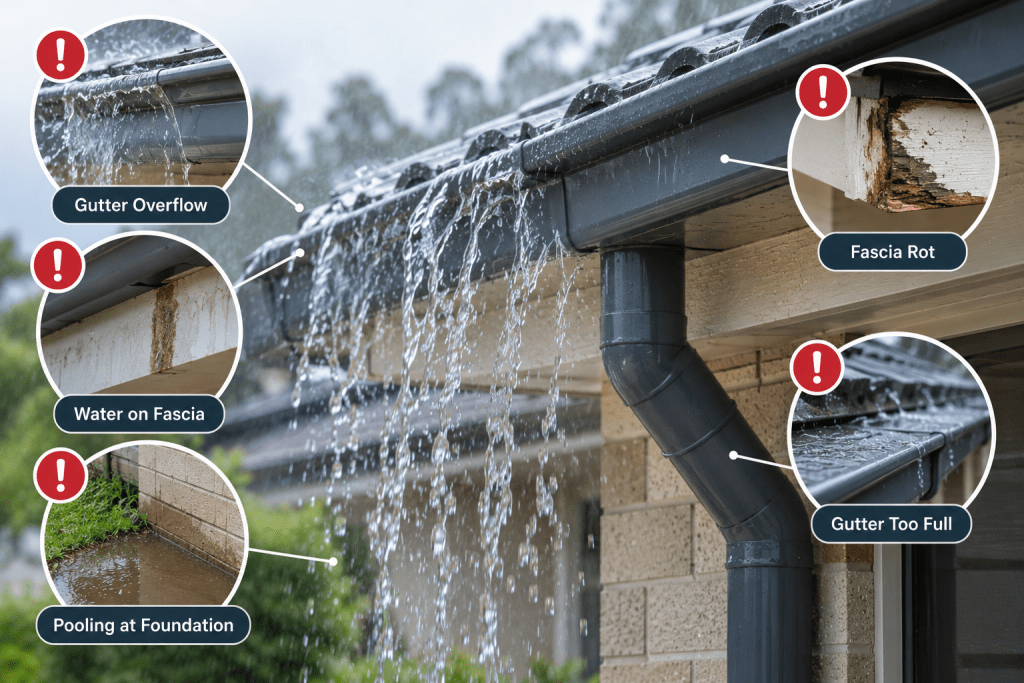
What Happens When Gutters Are Undersized
An undersized gutter doesn’t fail quietly. The most obvious sign is gutter overflow during heavy rain, where water sheets over the front edge of the gutter instead of draining through the downpipes.
That overflow doesn’t just make a mess. It sends water straight down the side of the house, where it can pool around the foundations, and over time that repeated pooling can contribute to damp issues at ground level.
There’s also a slower, less obvious failure mode. Water that runs back over the gutter edge or sits in an overloaded gutter for longer than it should tends to track down the fascia board behind it, and constant wetting like this is what leads to fascia rot. By the time the timber is visibly soft or discoloured, the damage has usually been building for longer than the overflow alone suggests.
How to Tell If Your Gutters Need Resizing
A few practical signs point to a sizing problem rather than a simple blockage:
- Overflow happens in moderate rain, not just extreme storms
- Water tracks visibly down the fascia even when the gutters have been recently cleaned
- Overflow started or got worse after an extension, new roof section, or deck was added
- Pooling appears in the same section of the foundation every time it rains heavily
- The gutter looks full or close to full well before the rain event has finished
If gutters are clean and overflowing is still happening, sizing is the most likely explanation, and it’s worth getting the roof properly assessed rather than assuming it’s a one-off blockage. Gutters overflowing repeatedly after a clean is one of the clearest signals that sizing, not maintenance, is the real issue.
Full Replacement vs Upsizing: Which Fix Is Right
Once undersizing is confirmed, the right fix depends on how the existing system is set up and how much extra capacity is actually needed.
In some cases, the gutters themselves are close to adequate, but the downpipes are the bottleneck. If water reaches the downpipe outlet faster than it can be carried away, the gutter overflows even if its profile is a reasonable size. In this scenario, a downpipe replacement with a larger diameter, or running an additional downpipe on a long gutter section, can solve the problem without touching the guttering itself.
In other cases, the gutter profile is genuinely too small for the catchment area now draining into it, usually after an extension or added roof section, and the only real fix is upsizing the gutter profile, often alongside a downpipe sizing upgrade to match the new capacity. This is a larger job than a downpipe fix alone, since it involves removing and replacing the existing gutter run rather than adding capacity at the outlet.
Cost is the other side of this decision. A downpipe upgrade is a smaller, more contained job. A full regutter is a bigger investment, but it’s the only real fix when the gutter profile itself can’t handle the catchment area.
Getting an accurate gutter replacement cost quote for your specific roof is the best way to compare the two options properly, since the right call depends on your roof’s catchment area, existing gutter condition, and how the current downpipes are performing.
Get Your Gutters Assessed by Roof Plumber Melbourne
If your gutters are overflowing and you’re not sure whether the fix is a downpipe upgrade or a full regutter, the safest first step is getting them properly assessed rather than guessing.
Our team can measure your roof’s actual catchment area, check your existing downpipe capacity, and tell you plainly whether upsizing or a full replacement is the right call for your home. Get in touch with Roof Plumber Melbourne to book a gutter assessment.