

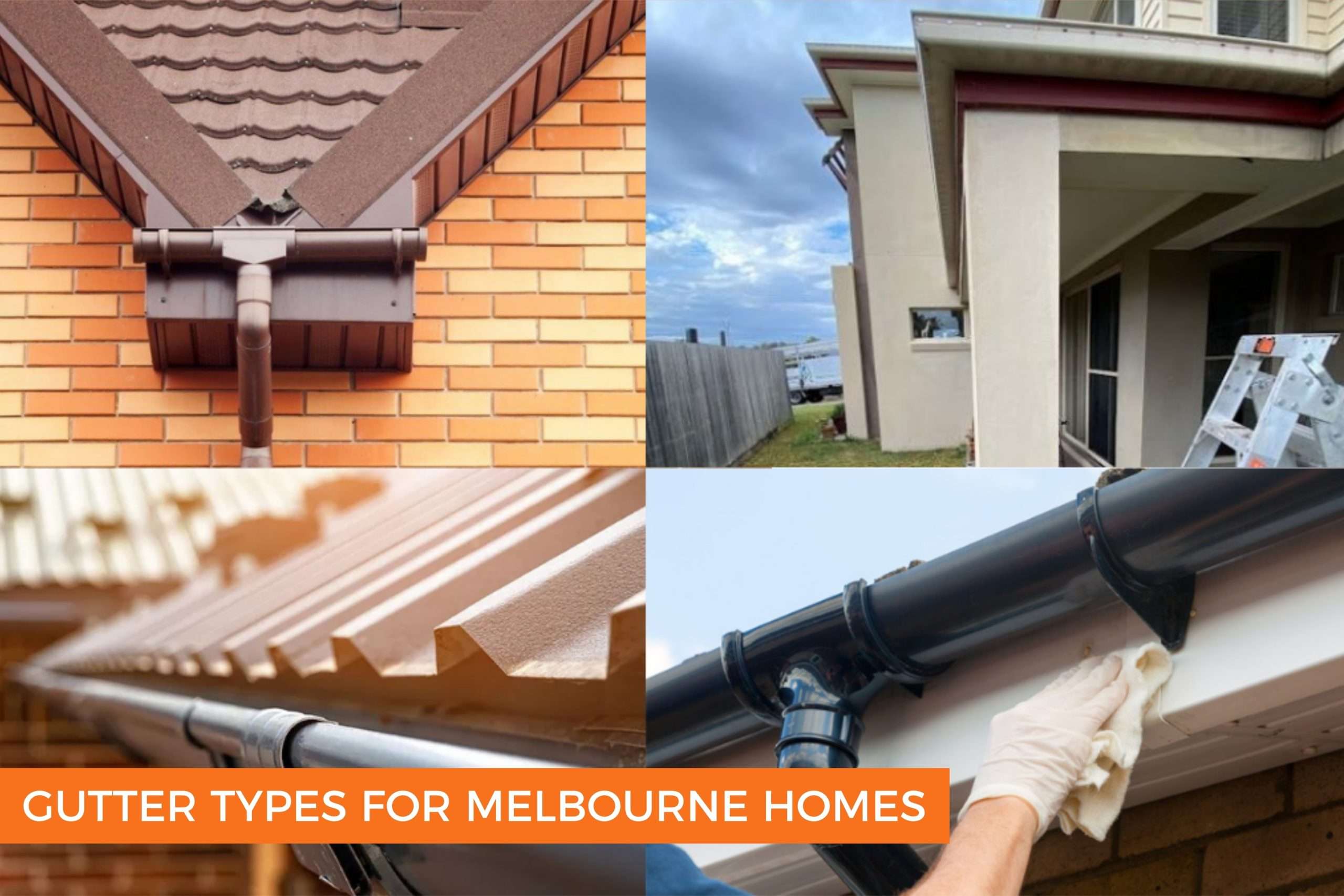
What Type of Gutters Should You Choose for Your Melbourne Home?
Most homeowners only think about gutters when they start failing, and by then the choice has usually been made for them by whoever quotes first. But gutters aren’t a single product you replace like for like. The profile, the material and the sizing all change how well the system copes with a Melbourne downpour, and the right combination depends on your roof.
This guide walks you through what you’re actually choosing between, so you can talk to a roof plumber as an informed owner rather than just a price-getter.
The Four Gutter Profiles and What Each One Suits
Profile is the shape of the gutter as you’d see it in cross-section, and it’s the first real decision. Four profiles cover the vast majority of Melbourne homes, and each one earns its place on a different kind of roof.
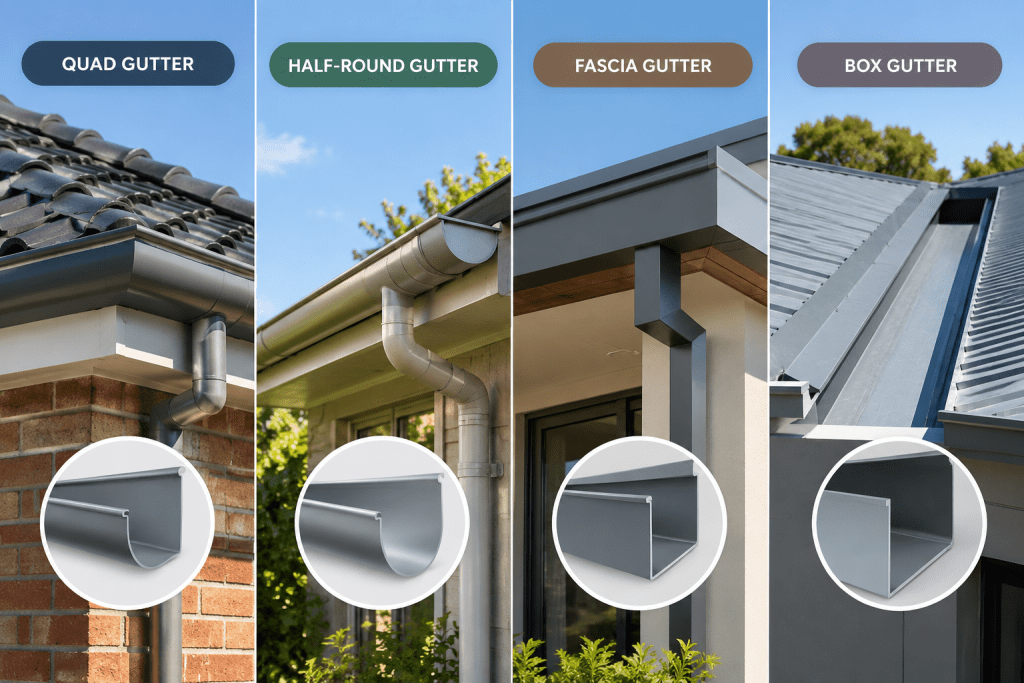
Quad Gutter
Quad is the profile you’ll see on most suburban Melbourne homes, and for good reason. It has a rounded front and a flat back, sits neatly against the fascia, and comes in both standard and high-fronted versions.
The high-front variety carries more water and is worth specifying if your roof sheds a lot at once. Quad is affordable, widely stocked, and suits the majority of pitched tiled and metal roofs, which is exactly why it’s become the default.
Half-Round Gutter
Half-round is a true semicircle, and it’s as much an aesthetic choice as a functional one. The shape self-cleans well because there are no square internal corners for debris to lodge in, and it flushes water efficiently.
You’ll most often see it on period and heritage homes where the curved profile matches the era, and on higher-end builds where the look matters. It usually costs more than quad and, on some homes, needs the right brackets to sit correctly.
Fascia Gutter
Fascia gutter does two jobs at once. It acts as both the gutter and the fascia board, presenting a tall, flat face to the street with no separate timber behind it. That gives a clean, contemporary line and a large water-carrying capacity, which makes it a strong choice for modern homes and lower-pitch roofs that dump water quickly.
Because it’s an integrated system, it needs precise installation, and repairs can be a little more involved than swapping a length of standard gutter.
Box Gutter
Box gutters are a different animal. They’re rectangular channels built into the roof structure itself, usually concealed between roof planes or behind a parapet, and they’re common on older Melbourne homes, terraces, warehouse conversions and flat-roofed extensions.
They shift a great deal of water, but because they sit within the roof envelope, a failure sends water straight into the building rather than over the edge. Box gutters demand correct falls, sumps and overflow provisions, and they are firmly specialist territory rather than a DIY proposition.
Quick Comparison at a Glance
| Profile | Capacity | Best suited to | Typical home |
|---|---|---|---|
| Quad | Moderate to high | Most pitched roofs | Standard suburban homes |
| Half-round | Moderate | Homes wanting a period look | Victorian, Edwardian, heritage |
| Fascia | High | Low-pitch, high-runoff roofs | Modern and contemporary builds |
| Box | Very high | Concealed and flat-roof drainage | Terraces, warehouses, extensions |
Your Roof Pitch Decides More Than Your Taste Does
It’s tempting to choose on looks alone, but the shape of your roof has the bigger say. A steep roof sheds water fast and concentrates it at the edge, while a low-pitch roof spreads runoff over a longer period but gives the gutter less help moving it along.
Match the profile to the pitch and the system copes; get it wrong and you’ll see overflow in heavy rain no matter how new the gutter is.
Work Out Your Catchment Area Before You Get a Quote
Catchment area is the amount of roof draining into a given gutter, and it’s the figure that actually drives sizing. It isn’t your floor plan; it’s the projected area of roof feeding that run, with an allowance for any wall above that drains into the same gutter.
Australian gutter and downpipe sizing is governed by AS/NZS 3500.3, and in Victoria all plumbing work has been required to meet the 2025 edition since 20 October 2025, enforced by the Building and Plumbing Commission.
In short, gutters must be sized for a serious storm rather than an average shower, and a good roof plumber will calculate this rather than guess it. Knowing roughly how much roof feeds each side of your house helps you sense-check the quote you’re given.
Why Two Identical Homes Can Need Different Gutters
Two houses that look the same from the street can genuinely need different systems. One might have a large tree dropping leaves into the run, which pushes you toward a self-flushing profile or gutter guard. Another might sit lower on the block with a wall draining into one side, increasing the catchment on that run alone.
Orientation, the number and placement of downpipes, and even how close you are to the bay all shift the answer. It’s why an off-the-shelf recommendation is worth so little, and why the same fault can call for a different repair or replacement decision from one home to the next.
Choosing the Right Gutter Material
Once the profile and sizing are settled, material decides how long the system lasts and how much upkeep it asks of you. In Melbourne’s climate the gap between the options is wider than most people expect.
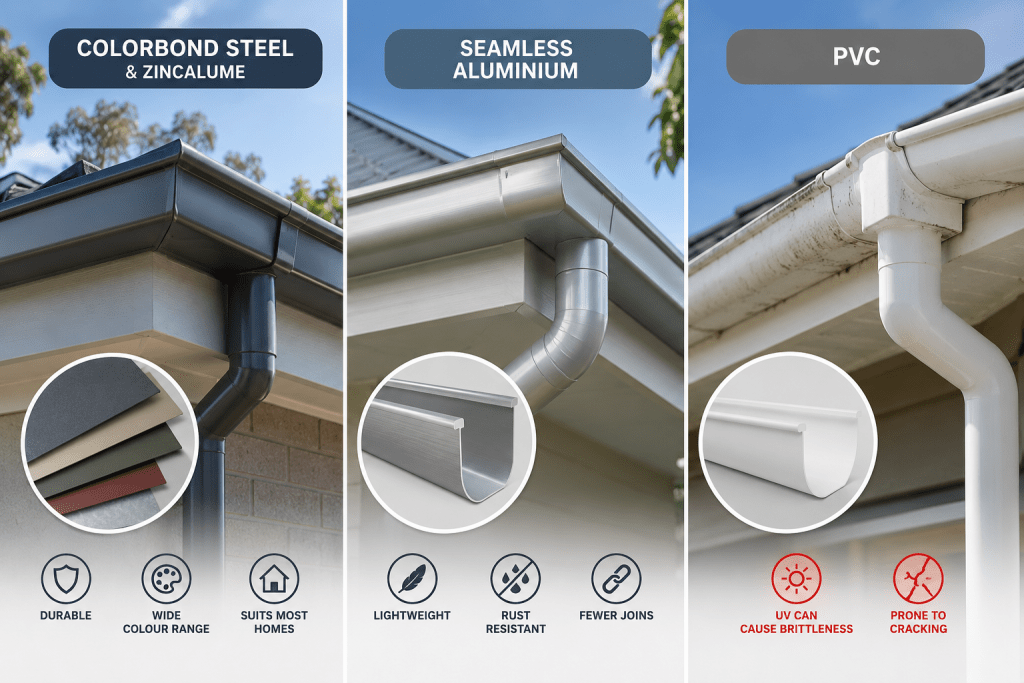
Colorbond Steel and Zincalume
Colorbond steel is the standard choice for good reason. It’s a colour-bonded finish over a zinc-aluminium alloy base, and it comes in the full range of colours to match your roof and fascia. A well-installed system runs comfortably for decades before it needs attention.
Zincalume, the unpainted alloy-coated steel, offers slightly lower corrosion resistance in a plain metallic finish and suits sheds, rural blocks and budget builds. For most Melbourne homes sitting away from the coast, Colorbond is the sensible middle of the road: durable, good-looking, and easy to source in any profile.
Seamless Aluminium
Aluminium resists rust naturally and holds its finish well over a long service life, which makes it a genuine option for homeowners who want a low-corrosion system. Being seamless, it has fewer joins to fail, and joins are where a lot of gutters give up first.
The trade-off is softness, because aluminium dents more readily than steel, and that’s worth thinking about in a city that cops summer hail and the occasional stray ladder. If your property is reasonably sheltered from hail, it’s well worth putting on the shortlist.
PVC Is Cheap Today and a False Economy Long Term
PVC is the cheapest option at the point of purchase, and that low upfront price is the whole of its appeal. Under the sustained UV that Melbourne summers deliver, it grows brittle and loses the flex a gutter needs to handle a hot day’s expansion and contraction.
The joints and brackets tend to fail first, and once a section cracks there’s no repairing it, only replacing it. Add in how easily ageing plastic splits under hail, and a saving that looked good on quote day quietly turns into a series of repair bills.
For a permanent roofline on a Melbourne home, it’s a false economy, and it’s the one material we’d steer most owners away from when planning a gutter replacement.
Making the Call on Your Gutters
Put the three decisions together and the right system falls out of them rather than being sold to you: a profile that suits your roof type and the look you’re after, a capacity set by your pitch and catchment, and a material that will still be doing its job in twenty years rather than a handful.
Heritage homes reward a little extra thought, since a half-round profile in Colorbond can hold the period character while performing like a modern system.
If you’d rather not work it out alone, that’s exactly what a proper assessment is for. The licensed roof plumbers at Roof Plumbers Melbourne will look at your roof, measure the catchment, and recommend a profile and material suited to your home, with no obligation attached. Get in touch for a free quote and you’ll know precisely what you’re choosing, and why, before a cent is spent.