

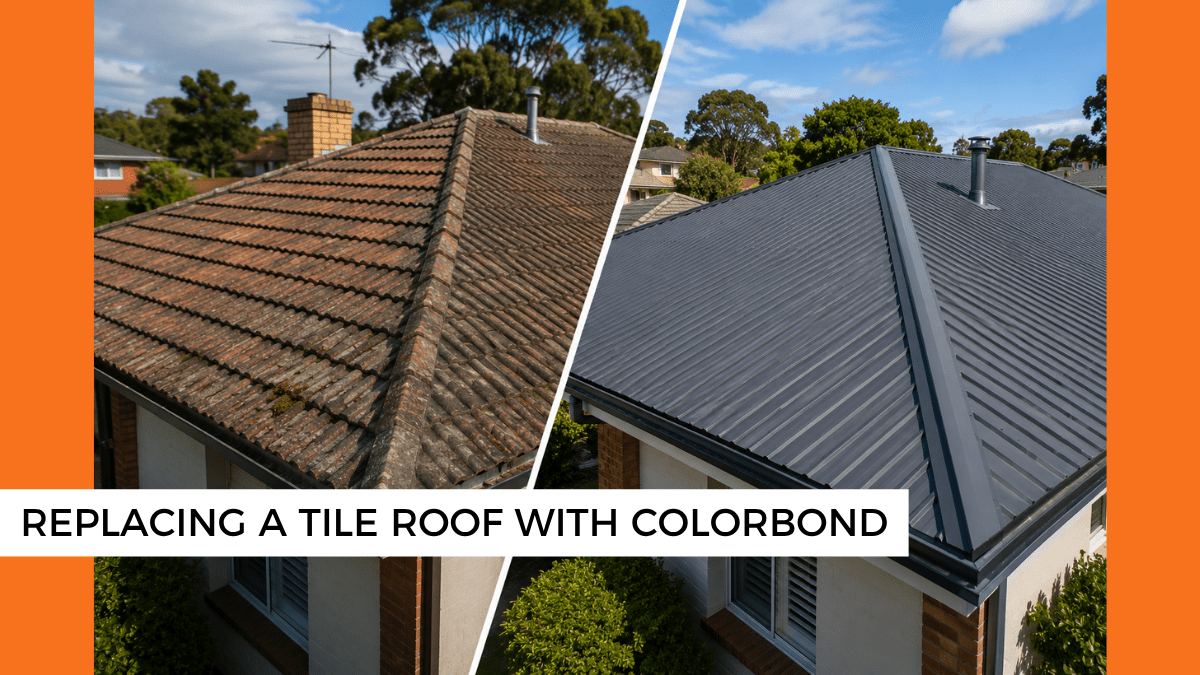
Replacing a Tile Roof with Colorbond: Is It Worth It?
If your tile roof is leaking again, cracking in new places, or costing more to maintain than it should, you’ve probably started weighing up your options. One of the most common questions Melbourne homeowners ask us is whether it’s worth the investment to replace a tile roof with Colorbond, or whether they should simply retile. This guide breaks it all down.
Why tile roofs reach a point of no return
Concrete and terracotta roof tiles are a staple on Melbourne homes, and for good reason. They’re solid, weather-resistant, and can last decades when properly maintained. But “properly maintained” is where things start to unravel.
As tile roofs age, homeowners typically face a familiar cycle of problems:
- Ridge capping mortar cracks and loosens, allowing water into the roof cavity
- Individual tiles crack or shift, creating entry points for leaks
- Moss, lichen, and debris build up, trapping moisture and accelerating deterioration
- Bedding and pointing need replacing every 10 to 15 years, which costs $40 to $90 per lineal metre in Melbourne
At some point, the cost of patching and restoring adds up to more than the cost of replacing the roof entirely. That’s the tipping point where many homeowners start comparing tile roof vs Colorbond to work out which direction makes financial sense.
Colorbond is lighter, and that changes more than you'd think
Weight is one of the biggest practical differences between the two materials, and it affects far more than just the roof itself.
What the weight difference means for your roof frame
A standard concrete tile roof weighs between 40 and 60 kg per square metre for the tiles alone. When you factor in the full roof assembly (tiles, battens, insulation, ceiling lining, and timber framing), the total load sits at roughly 90 kg/m².
A Colorbond steel roof, by contrast, weighs around 5 kg per square metre for the sheeting. The full assembly (sheeting, insulation, ceiling, and timbers) comes to approximately 40 kg/m².
That’s less than half the total load. For an average Melbourne home, removing heavy tiles and replacing them with Colorbond can take several tonnes of dead weight off the structure, reducing long-term stress on walls, lintels, and footings.
Will your home need structural work first?
In most cases, switching from tile to Colorbond doesn’t require structural reinforcement, because you’re going from a heavier material to a lighter one. However, the change in weight does affect how your roof responds to wind uplift. A lighter roof has less resistance to upward wind pressure, which means hold-down fixings, bracing, and batten spacing may need to be reassessed by a structural engineer.
Your roofing contractor should arrange or recommend this assessment as part of the quoting process.
What does it actually cost to make the switch?
Cost is usually the first question homeowners ask, and the answer varies depending on your roof’s size, pitch, complexity, and access.
Tile-for-tile replacement vs. switching to Colorbond
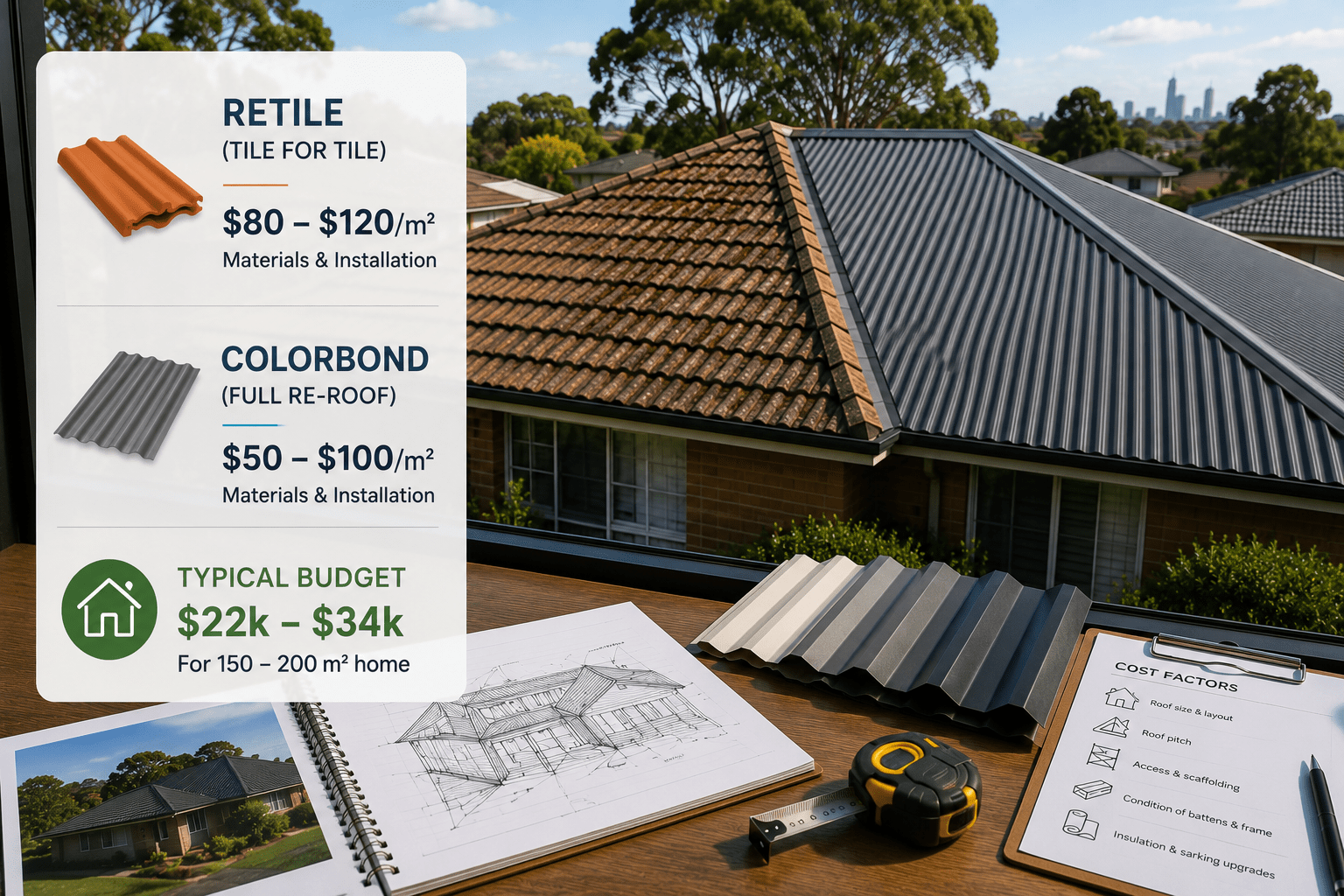
The tile roof replacement cost for a like-for-like retile (removing old tiles and installing new concrete or terracotta) typically runs between $80 and $120 per square metre for materials and installation. The colorbond roof cost for a full re-roof (materials plus labour) generally falls between $50 and $100 per square metre, depending on the profile and colour you choose.
While the per-metre material cost can favour Colorbond, the overall cost to replace tile roof with Colorbond tends to be higher than a simple retile because the job involves more steps (tile removal, disposal, batten assessment, and potential structural review).
What affects the price in Melbourne
Several factors influence the final replace tile roof with Colorbond cost:
- Roof size and layout (valleys, hips, and penetrations add complexity)
- Roof pitch (steeper roofs increase labour time and safety requirements)
- Access (two-storey homes or tight sites often require scaffolding)
- Condition of existing battens and framing (damaged timber adds to the scope)
- Whether insulation and sarking are upgraded at the same time
What should you budget for?
For a typical Melbourne home with a 150 to 200 m² roof area, a mid-range Colorbond full replacement — including tile removal, new battens, sarking, insulation, and updated guttering — generally costs between $22,000 and $34,000, or roughly $80 to $150 per square metre installed.
Premium profiles, two-storey scaffolding, asbestos removal, or structural repairs uncovered once the tiles are off can push the total to $35,000 or more.
So how much to replace tile roof with Colorbond on your home? The only reliable way to find out is to get a detailed, itemised quote based on a physical roof inspection. Any contractor quoting without one should be a red flag, because the price can shift significantly once the tiles are off and the frame is exposed.
Where Colorbond wins long-term: maintenance costs
This is where the colorbond vs tile roof comparison tips decisively. Tile roofs require ongoing maintenance to stay watertight: repointing every 10 to 15 years, broken tile replacements after storms, periodic cleaning to prevent moss buildup, and occasional valley or flashing resealing. Over two decades, those costs add up to thousands of dollars.
Colorbond needs very little by comparison. A hose-down once or twice a year and a periodic fastener check is typically all that’s required. There’s no mortar to crack, no tiles to shift, and no ridge caps to rebed.
Will Colorbond suit the look of your home?
This is a fair concern, especially for period-style homes. Colorbond has come a long way from the corrugated iron of decades past. The current range includes 22 core colours in a Classic finish, plus 6 in a premium Matt finish, with options that suit everything from weatherboard cottages to contemporary builds.
If your home has a more traditional character, neutral tones like Woodland Grey, Shale Grey, or Paperbark can complement heritage colour palettes without looking out of place. For modern homes, deeper options like Monument or Basalt are popular for their clean, architectural feel.
The shift from tiles to Colorbond almost always modernises a home’s appearance, which tends to boost street appeal and can support resale value.
What the installation process looks like
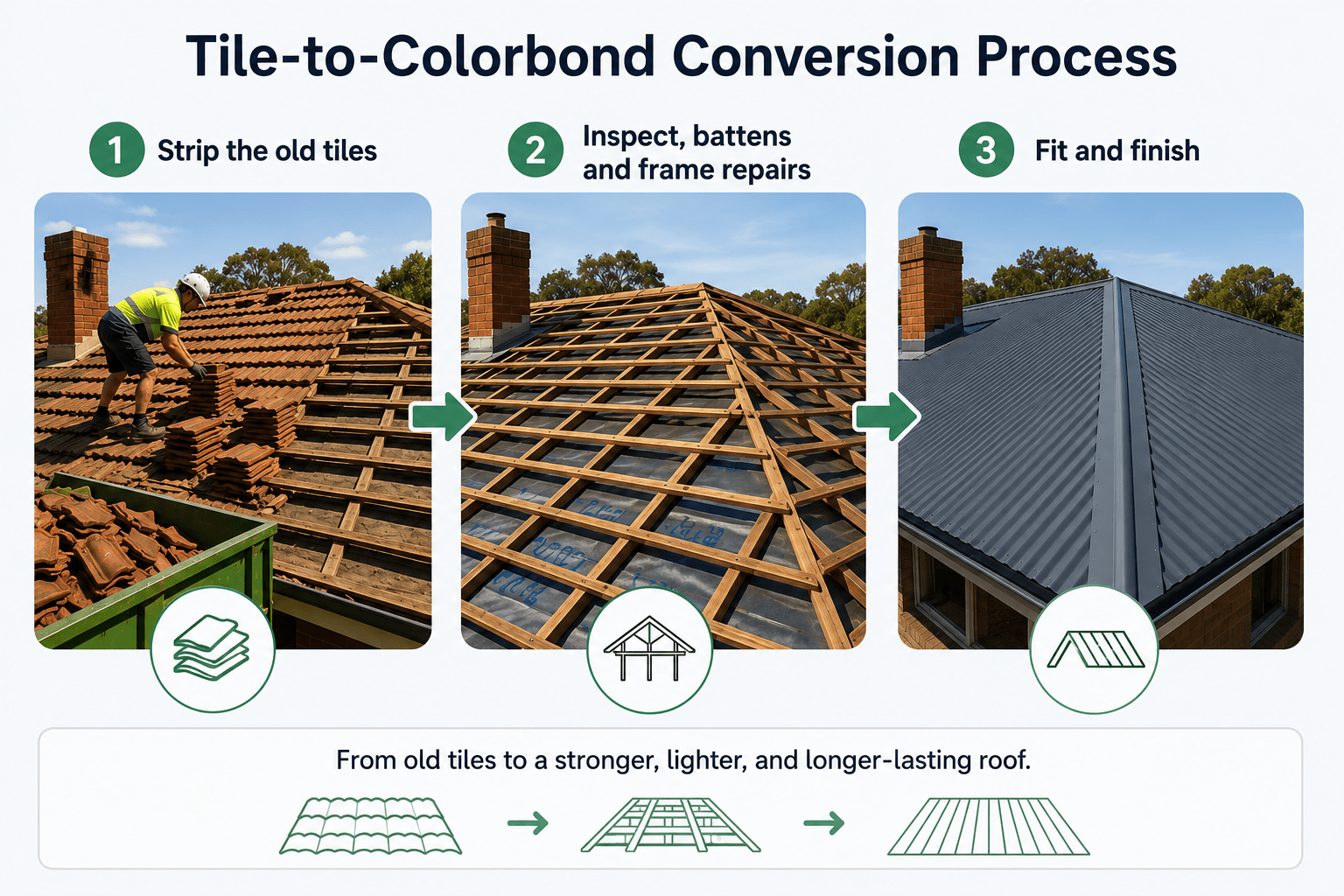
A tile-to-Colorbond conversion follows a structured sequence. Knowing what to expect helps you plan around the disruption.
Stripping the old tiles
The existing tiles are removed by hand, stacked, and loaded into a skip bin for disposal. This is the most labour-intensive part of the job and one of the reasons tile removal costs more than removing an old metal roof.
Inspection, battens, and frame repairs
Once the tiles are off, the roof frame is exposed and inspected. Battens are checked for rot, splitting, or incorrect spacing (Colorbond sheeting requires different batten centres to tile). Damaged timber is replaced, and any structural modifications recommended by the engineer are completed at this stage. Sarking (a waterproof membrane) is also installed beneath the new roofing.
Fitting and finishing
Colorbond sheets are measured, cut, and fixed to the battens. Flashings go around penetrations, valleys, and edges, followed by ridge capping, guttering, and downpipes. A quality Colorbond and metal roofing installation should be watertight from day one, with no bedding, pointing, or curing time required.
Questions to ask your contractor before you commit
Before signing a quote for a roof replacement, make sure you have clear answers to the following:
- Is a structural engineering assessment included or arranged as part of the job?
- What Colorbond profile and thickness (BMT) are you quoting on?
- Does the quote include full tile removal, disposal, new battens, sarking, and flashings?
- What warranty do you offer on workmanship, and what does BlueScope’s material warranty cover?
- Will you need scaffolding, and is that included in the quote?
- How long will the job take, and will the house be weatherproofed overnight if the job spans multiple days?
- Are you a licensed roof plumber registered with the Victorian Building Authority?
A good contractor won’t hesitate to answer these questions in detail. If they can’t, keep looking.
Is it worth it?
For most Melbourne homes with ageing tile roofs, the answer is yes. The upfront cost is higher than a retile, but you get a lighter, more durable roof that requires almost no maintenance. When you factor in the savings on repointing, tile replacements, and cleaning over the next 20 to 30 years, Colorbond consistently comes out ahead.
If your tile roof is at the point where restoration isn’t enough, talk to a licensed Melbourne roof plumber about your options. Roof Plumbers Melbourne offers free, no-obligation quotes with no call-out fees, backed by a 20-year workmanship warranty and a licensed team available 24/7. Call 1300 692 392 or request a free quote online for same-day bookings.