


Colorbond Roof Lifespan: How Long Does It Last?
Ask most roofing contractors, and you’ll hear the same answer: around 40 years. While that’s a reasonable estimate, some Colorbond roofs last over 50 years, while others show wear in less than 15. The difference usually comes down to installation quality, maintenance, and Melbourne’s local conditions, not the material itself. This post explains what really affects a Colorbond roof’s lifespan.
The Stated Colorbond Roof Lifespan and What It Really Means
The “40 years” figure comes from the general performance expectations for Colorbond steel in standard Australian residential conditions, not from a specific manufacturer’s guarantee. It represents what a correctly installed, properly maintained roof can reasonably be expected to deliver, though in practice, Colorbond roof lifespan varies considerably depending on environmental exposure, installation quality, and maintenance history.
The figure also doesn’t account for variability between locations. A roof in a bayside Melbourne suburb exposed to salt air will age differently from one in an inland suburb with no coastal influence, and a roof installed with incorrect fasteners will show early corrosion regardless of the product quality. The material’s reputation for longevity is well-earned, but it assumes everything else has been done correctly.
What the Colorbond Roof Warranty Covers and What It Doesn't
BlueScope, the manufacturer of Colorbond steel, offers a material warranty rather than a workmanship or performance warranty – an important distinction that’s worth understanding before you sign off on any job. The Colorbond warranty covers the steel product itself against specific types of deterioration, but it does not cover installation errors, storm damage, or general wear from poor maintenance.
The standard Colorbond roof warranty covers up to 36 years against corrosion to perforation and up to 20 years against the paint system flaking or peeling due to natural weathering. These figures represent the maximum coverage – the actual warranty period for your specific roof depends on your location, roof pitch, and installation details. To qualify, the roof must have a pitch of at least 5 degrees, must be fully lined without unwashed or sheltered areas, and must be located more than 5km from saltwater.
The 5km coastal rule matters for Melbourne. Bayside suburbs, including Brighton, Sandringham, Williamstown, and St Kilda, fall within proximity to Port Phillip Bay. For homes in these areas, standard Colorbond may not qualify for the full warranty period. BlueScope recommends Colorbond Ultra, its enhanced product for coastal and marine environments, and the Colorbond Ultra warranty applies different coverage thresholds for homes within relevant distance from saltwater.
Fasteners are also a warranty condition and must comply with Australian Standard AS3566 – Class 3 for standard locations, Class 4 for coastal environments. Non-compliant fixings can void the warranty. The warranty also requires active application through BlueScope’s online Warranty Management System, so if your installer doesn’t raise it, ask them to apply before work is complete.
What Shortens a Colorbond Roof's Lifespan and What's Actually in Your Control
A well-specified Colorbond roof installed correctly should perform for decades without significant issues. The factors that cut that lifespan short are almost always preventable, and most are the result of decisions made at installation or neglect during the years that follow.
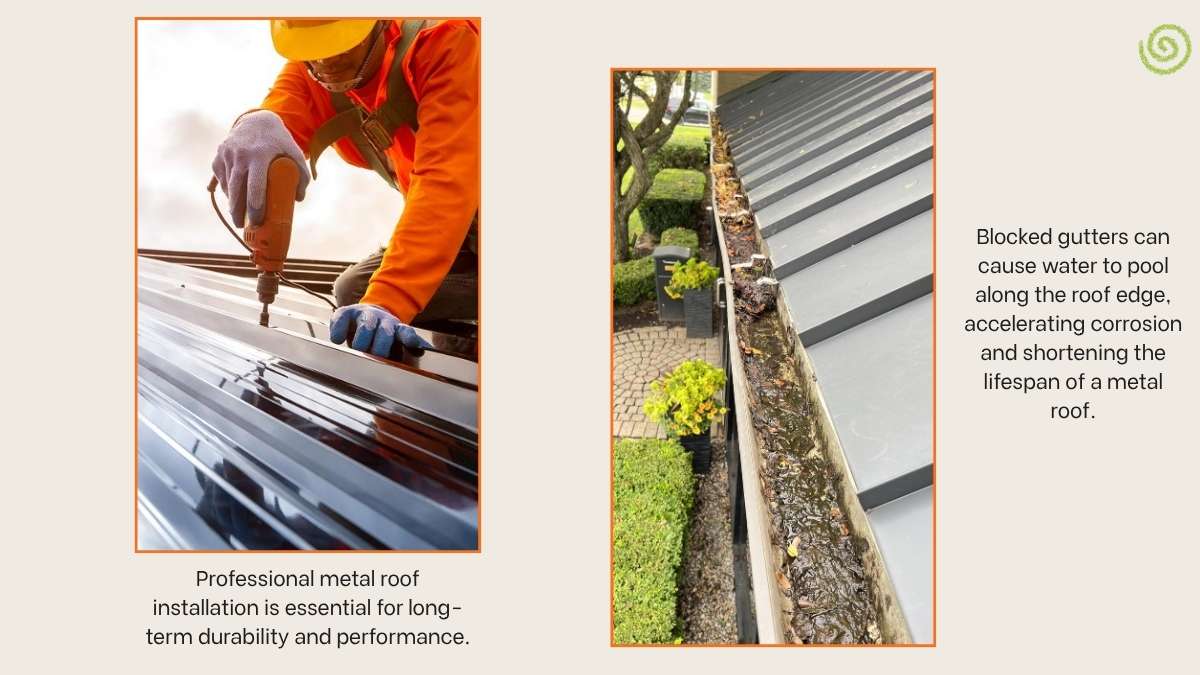
Poor Installation - The Risk That Shows Up Years Later
Installation errors don’t always show up immediately. A roof can look fine for the first few years and begin deteriorating noticeably in year eight or ten as minor issues compound. Common problems include fixings that are over-driven or incorrectly specified, sheeting that hasn’t been lapped or sealed correctly, and flashing details that allow water to track into the roof structure.
None of these are visible on a finished roof, which is why the only real protection is choosing an experienced roof plumber who understands the manufacturer’s installation requirements and asking specifically about compliance before work begins. If you suspect existing issues, arranging roof repairs early prevents minor installation faults from becoming structural ones.
Dissimilar Metals, Blocked Gutters, and Other Silent Lifespan Killers
Dissimilar metals are one of the most common and least understood risks. BlueScope is explicit on this point: copper pipes and lead flashing must not come into direct contact with Colorbond steel, and water must not run from these materials onto the roof sheeting or gutters. When copper or lead ions are carried onto Colorbond, galvanic corrosion accelerates at the contact point, a particular risk on older homes where lead flashing is already present or copper overflow pipes discharge onto the roof.
Blocked gutters present a slower but equally damaging problem. Leaf litter and debris cause water to pool against the roof sheeting edge, and that standing moisture accelerates corrosion at the roof margins, which is why keeping gutters clear directly affects how long the roof lasts, not just how it looks.
Overhanging branches and debris accumulation in roof valleys compound the issue further. The warranty specifically excludes areas not washed by rain, so any sheltered section of your roof that isn’t actively cleaned falls outside warranty coverage regardless of its age.
What Extends a Colorbond Roof's Life and Keeps the Warranty Valid
The same practices that keep the warranty valid are the ones that genuinely extend the roof’s life.
Regular Colorbond roof cleaning is the most important and most overlooked maintenance task. BlueScope recommends washing any areas not normally reached by rain at least every six months using fresh water from a garden hose, high-pressure washing is not recommended as it can damage the paint coating. For most suburban Melbourne homes, this means sheltered sections under eaves or near walls rather than the open roof surface.
Keeping gutters clear prevents pooling at the roof margins, and inspecting fixings and flashings after significant hail events catches early issues before they worsen.
How Melbourne's Climate Affects Colorbond Roof Longevity

UV exposure is higher than many homeowners expect. Australia’s summer UV levels exceed those at equivalent latitudes in the northern hemisphere due to the southern hemisphere’s closer proximity to the sun, lower ozone levels, and cleaner air, all of which accelerate paint coating degradation over time. This is precisely what the 20-year paint warranty addresses, and why correct roof maintenance in Melbourne matters as much as it does.
Temperature cycling is pronounced in Melbourne, where large swings between hot summers and cool winters cause metal to expand and contract repeatedly. A correctly installed roof with appropriate fixing allowances manages this without issue, but rigidly fixed sheeting can develop fastener stress and early joint failure over time.
Coastal salt air affects a wider area than the immediate beachfront. Properties in bayside suburbs and anywhere within a few kilometres of Port Phillip Bay experience elevated salt deposition, accelerating surface corrosion if the roof isn’t washed regularly or the wrong product grade is specified.
Hail rounds out Melbourne’s climate challenges. While Colorbond is impact-resistant, severe hail can compromise the paint coating at impact points, and exposed steel will begin to corrode if left unaddressed. After any significant hailstorm, arranging a roof inspection is a worthwhile step before the damage progresses.
Colorbond Roof Maintenance - A Simple Schedule to Protect Your Investment
Every 6 months: Clear gutters and downpipes, wash roof areas not reached by rainfall using a garden hose, and check for debris in roof valleys.
- Annually: Inspect fixings, flashings, and penetrations for rust staining, movement, or sealant deterioration, and confirm downpipes are draining freely.
- After significant weather events: Inspect for hail impact marks or displaced flashings, and address any roof repairs promptly; small issues have a way of becoming significantly more expensive ones.
- Every 5-10 years: Arrange a professional roof inspection and condition report to assess remaining life and any pre-emptive maintenance that could extend it.
When maintenance alone isn’t sufficient, paint coating degrading across the surface, surface rust appearing, or the roof looking significantly worn, Colorbond roof restoration is often a more cost-effective path than full replacement. The Colorbond roof restoration cost is typically a fraction of a full re-roof, and done correctly, it can add meaningful years to the roof’s functional life.
A Long-Lasting Colorbond Roof Doesn't Happen by Accident
Colorbond roofing is genuinely durable, and a well-installed roof maintained correctly is one of the most reliable long-term investments a Melbourne homeowner can make. But that lifespan isn’t guaranteed by the product alone; it’s the result of correct installation, compatible materials, appropriate product selection for the location, and consistent maintenance in the years that follow.
If you’re evaluating Colorbond roofing for a new build or replacement, our Colorbond & Metal Roofing covers product options, profiles, and what the full installation process involves.